
Writing has become easy with AI. You can create whole content pieces within minutes. Our job is to review this output, and that's the hard part. Whether you are drafting a contract, policy, or report, it doesn't matter who does the initial run; what matters is who checks it, owns every word, and approves the work.
Writing is still the most common use of AI at work. In OpenAI's latest usage data, released in October 2026, writing accounted for 32.6 percent of work-related ChatGPT messages in September 2026, ahead of every other topic by 10 points. In 2026, both Anthropic and OpenAI shipped their own document editors. That tells you the chat window is not where the work ends. Usually, the content ends up in the documents within the applications companies run, in front of the people who have to approve it and are accustomed to the rich-text editing experience provided by our products.
Tiugo is the company behind TinyMCE and CKEditor. These two editors sit inside thousands of products where content creation is an important part of their work: banks, publishers, pharma, government, the software companies that serve them. We have watched this shift from inside those products for three years. This is what we have seen, and what we are building because of it.
Our view in one line: AI brings the agents; we bring the editing.
Writing is the largest single use for ChatGPT at work: 32.6 percent of work-related messages in September 2026, ahead of the next-largest topic, how-to and advice requests, at 22.9 percent.
Source: OpenAI Signals v3.0, released 26 October 2026, Consumer ChatGPT only (Free, Go, Plus and Pro), a sample of 1,000,000 messages a month.
Three generations in three years
We shipped our first AI assistant seven months after ChatGPT launched. A prompt box and a few quick actions like "improve writing". Customers used it, but they wanted a greater immersive experience, a conversation instead of a one-shot prompt. The AI had to work on a selection, a section, or a whole document, with context under their control. And above all, they wanted to see what it had changed before it changed anything.
We launched the second generation in 2025, with multi-turn chat with context control and agentic edits that land as suggestions for a person to accept or reject. On-premises, with the customer's own models and MCP connections, to meet their governance requirements.
The third generation arrived this year and it extended the relationship. Enterprises now bring their own agents and their own interfaces. A Big Four firm has made Claude Cowork the starting point for work across its internal applications. Its teams ask whether Claude can write directly into CKEditor. They want our editing: granular diffs, suggestions, and agents that can change a document safely while people keep working in it.
We shipped each of these steps with customers.
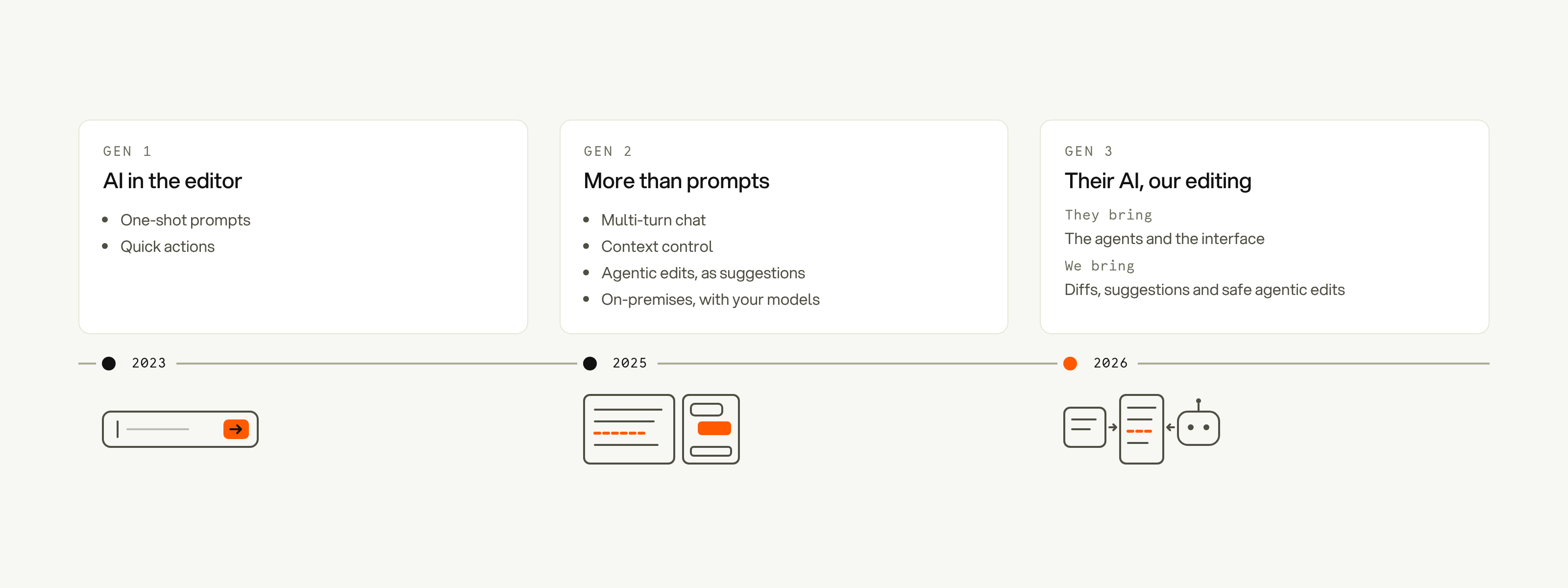
Figure 1. Three generations of AI editing at Tiugo, 2023 to 2026: from prompts in the editor to their AI, our editing.
What breaks when a model edits a document
Any AI editing demo looks fine: a model writes a paragraph and it appears on screen. The problems start in production, with real documents, a real editor configuration and real reviewers, and they take three forms we now see at every customer.
The first is that the model returns an entirely new paragraph rather than making changes. If we want to update a single date in a contract clause, it returns the entire clause rewritten, with the date corrected and 20 other words rearranged. It becomes increasingly hard for reviewers to see which of those changes they asked for, so they have to read the whole clause again as if it were new. Review stops being a check and becomes a rewrite of the rewrite.
The second is quieter. The model encounters a table it does not understand, a colored box, a side-by-side layout, or a formatting rule enforced by the editor configuration, and it drops it. The editor accepts what is left, and the loss is found weeks later or never. The third is the cost. Once a team has been burned like that, its engineers stop working on the feature the business asked for and spend the quarter writing prompt rules, examples, and cleanup code so the model's output fits what the editor can hold. The AI project turns into a markup compatibility project.
With 11 models editing 14 difficult documents, 18 percent of documents lost content when the models wrote straight into the editor. Once the same models worked through our server-side editing engine, which tells them what the editor supports before a change lands, it fell to under 1 percent.
Source: Tiugo internal benchmark, October 2026. 11 models, 14 documents, 43 quick edits, with and without Coauthor.
Typing and formatting text, the part most people picture when they hear "editor", is roughly a fifth of what we build. The other four-fifths are tables, track changes, comments, revision history, real-time collaboration, permissions, and import and export, and that is the part enterprises pay for. A model writing into the document barely touches the first fifth, and it puts the other four at risk, because each of those structures is something it can quietly break.
Two modes of AI writing, and they need different things
Everything we see at customers falls into two patterns.
In assisted writing, it is the person who works inside the editor and the AI helps on request. The person might be in our editor with our built-in AI, or in ChatGPT or Claude with the document reached from there. The outcome should be simple: every AI change arrives as a suggestion, so the user can review the content where it lives, with the formatting, comments, and permissions still attached.
In agentic writing, agents do most of the work with nobody in the editor. They wake on an event, a schedule, or another agent's request. One drafts, another checks policy and style and leaves comments, and the first one fixes what was flagged. A person comes in once at the end to review the suggestions and resolved threads and to accept, reject, or send them back. What this mode needs is validation before a change lands, attribution on every change, and a record a person can trust later.
The second mode makes the first one more important. The more a model writes, the more somebody has to read, approve and stand behind when the output matters.
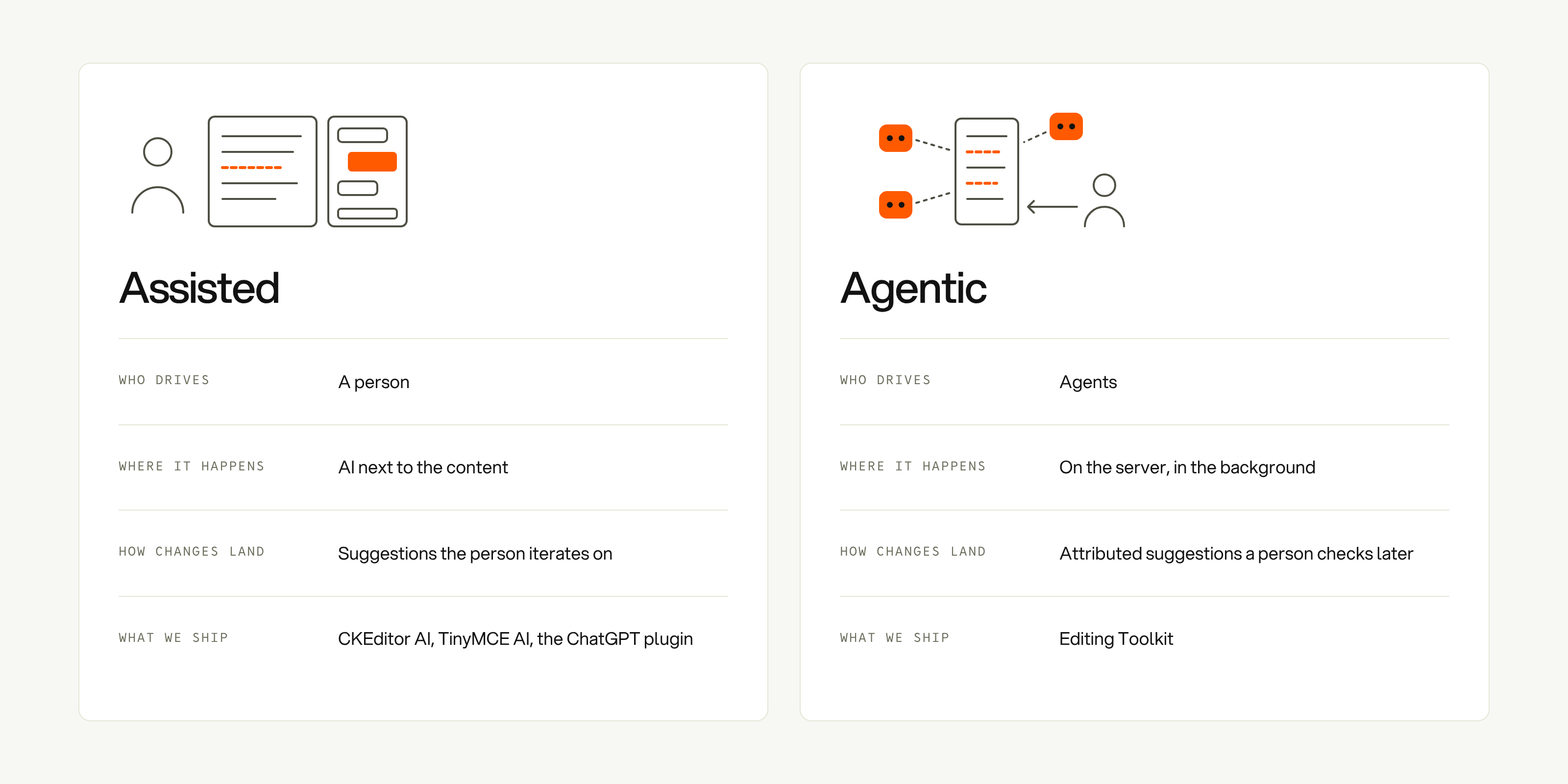
Figure 2. Two modes of AI writing, and what each one needs from the editor.
The Tiugo AI Platform
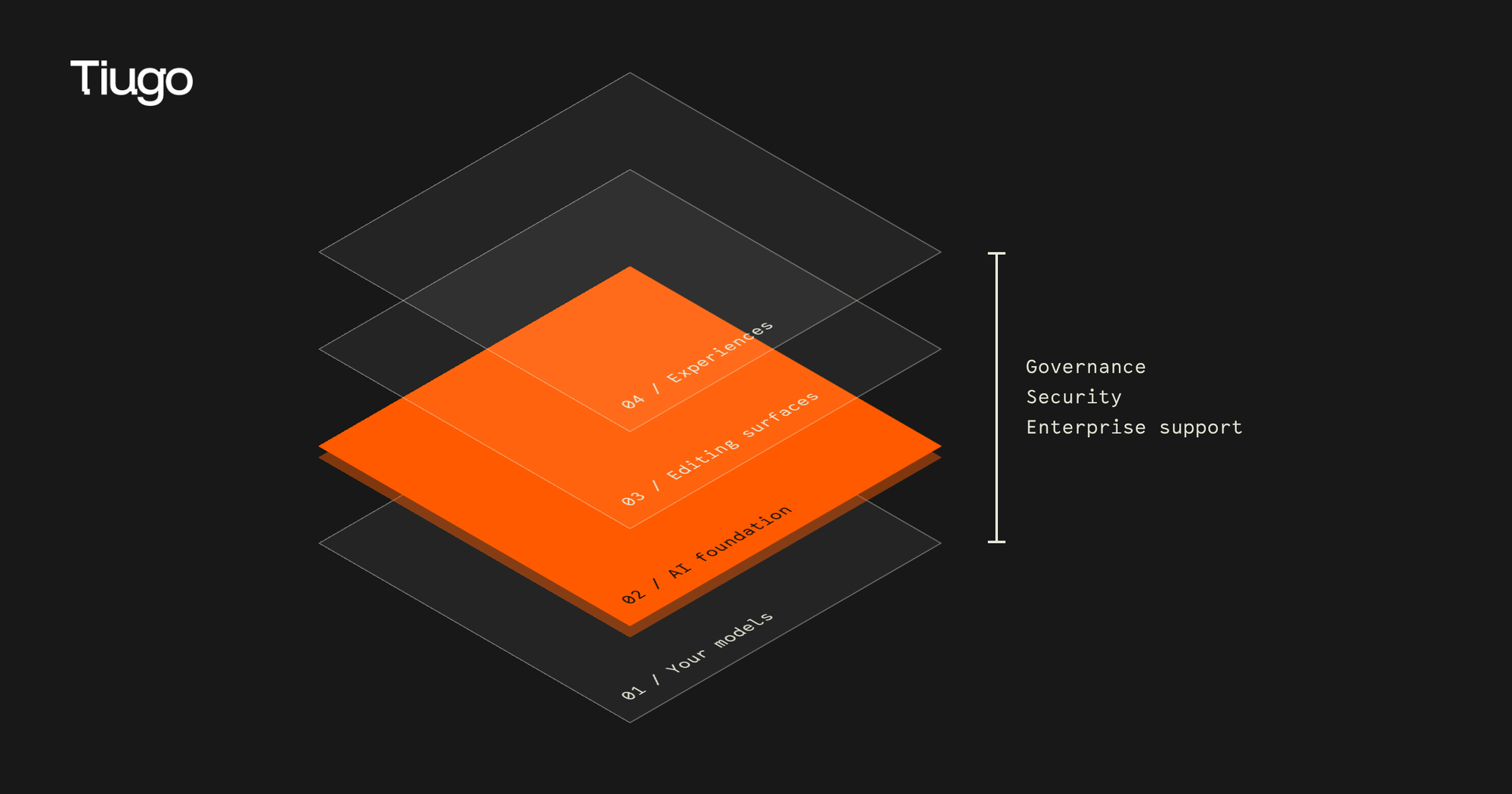
This is what we are building for both modes, and it has four layers.
At the bottom, your models. Customers choose the model, run it where their policy allows, on-premises if that is the rule, and connect their own AI gateways and MCP tools. We don't sell models and don't lock anyone into one. Customers already run our AI on-premises, with models they host themselves, in compliance with EU privacy rules.
Above that, the AI foundation: the platform services that make a model's output safe to apply to a document. Compare, which turns any new content into reviewable changes against the current document. Coauthor, the editing engine running on the server, exposed through MCP, the open standard most AI assistants now support, lets any agent read, edit, and verify content and tells them what the editor supports before a change lands. Evaluations among eleven models track the cost of each edit, and mark anything a change would lose before it lands.
One layer up, the editing surfaces where content actually lives: TinyMCE, the rich-text editor in thousands of products and AI-ready today. CKEditor, built for structured content and real-time collaboration. Document workspaces in the Notion style. Block-based content, which we are extending.
And on top of that, the experiences people meet: AI in the editor with chat, quick actions, reviews, and suggestions. AI in the chat applications people already use, ChatGPT today, Claude next, and any assistant that connects over MCP. Server-side agents that draft and fix with nobody in the editor. And the one experience every path ends in: a person reviewing and approving.
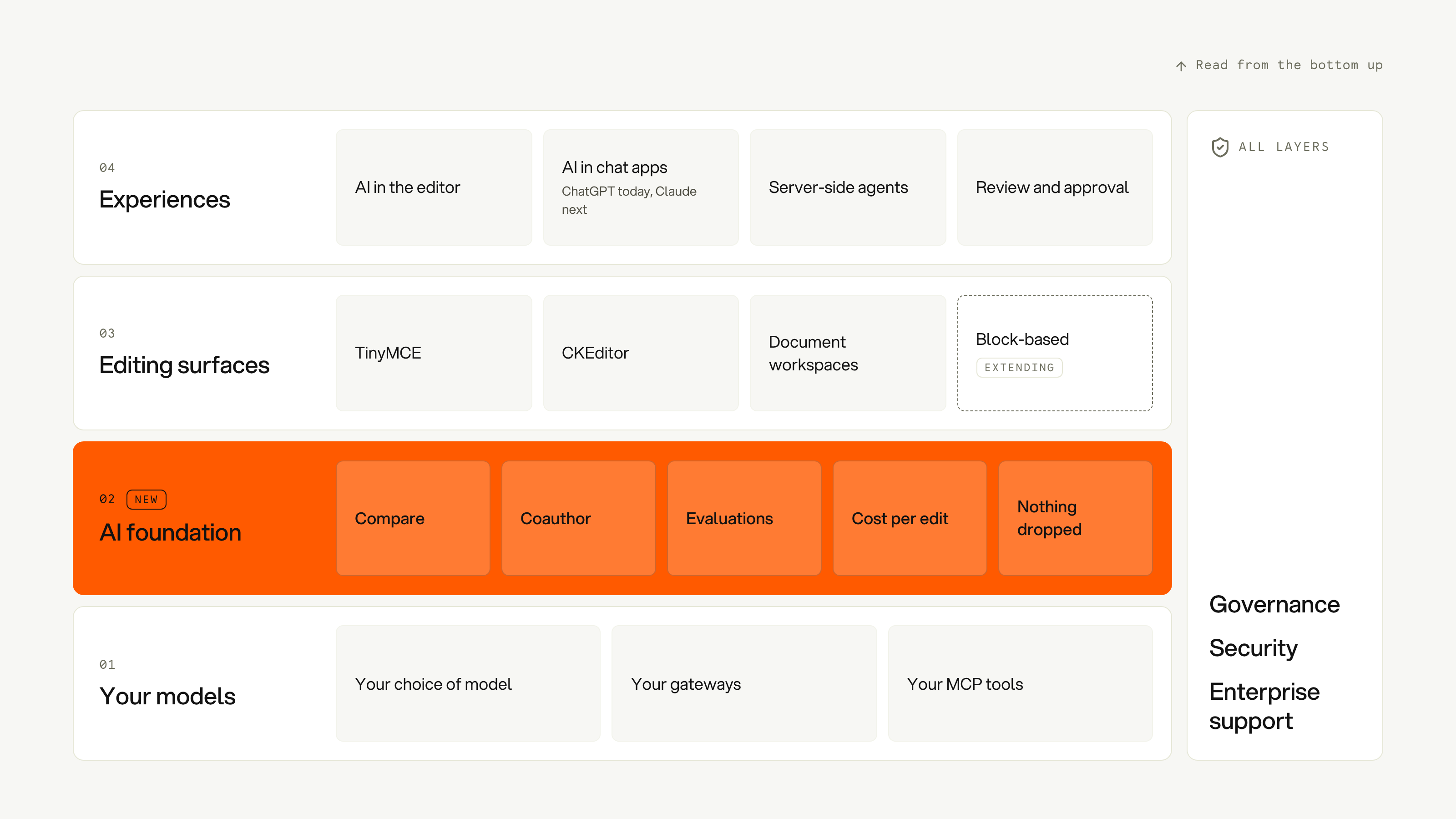
Figure 3. The Tiugo AI Platform: four layers, read from the bottom up, with governance, security and enterprise support across all of them.
Already shipping
All of this is shipping. Compare was released in November. Coauthor entered early access with customers the same month. CKEditor AI is in production with our clients, including on-premises: at one financial services firm, a single command now does in seconds what used to take 20 to 40 minutes of manual work. And last week we put a full CKEditor document inside ChatGPT: ask for a report in the conversation, and it opens in a real editor; every AI edit arrives as a suggestion you accept or reject, and your colleagues work on it with you from their own ChatGPT. It is live in the ChatGPT app directory for anyone to try.
"CKEditor Docs makes ChatGPT a place where documents get written, reviewed and shared. A familiar editor, collaboration with colleagues and their ChatGPT, and AI edits you approve one suggestion at a time. Great to see it in the ChatGPT plugin directory."
Arpan Shah, Enterprise Verticals, OpenAI. Quote approved by OpenAI, 5 November 2026.
What 2027 looks like
Three things, all of them about the person who reviews.
The right thing gets done. Config-aware validation ships with Coauthor today. We are adding a guarded structure, restricted editing, and fillable sections that keep agents within the template, and per-agent permissions down to the section level: what each agent may read, edit, suggest, or comment on.
Review stays fast. Granular suggestions already show one changed word as one word, which keeps the reviewer productive. We are adding a side-by-side comparison before you accept, and agents you can mention in a comment thread, who reply, ask, or suggest there as a colleague would.
Every claim can be traced. Agents will store the sources behind what they generate so every claim can be traced; reviewers will see where every statement came from inside the editor, and a source-check agent will verify citations before anything is suggested.
The companies that get this right will let their people start work wherever they like, in a chat, in an app, in a document, and still have one place where the content is reviewed, approved and owned. That place is the application they already trust. Our job is to make the editor inside it ready to accept writing from anywhere.
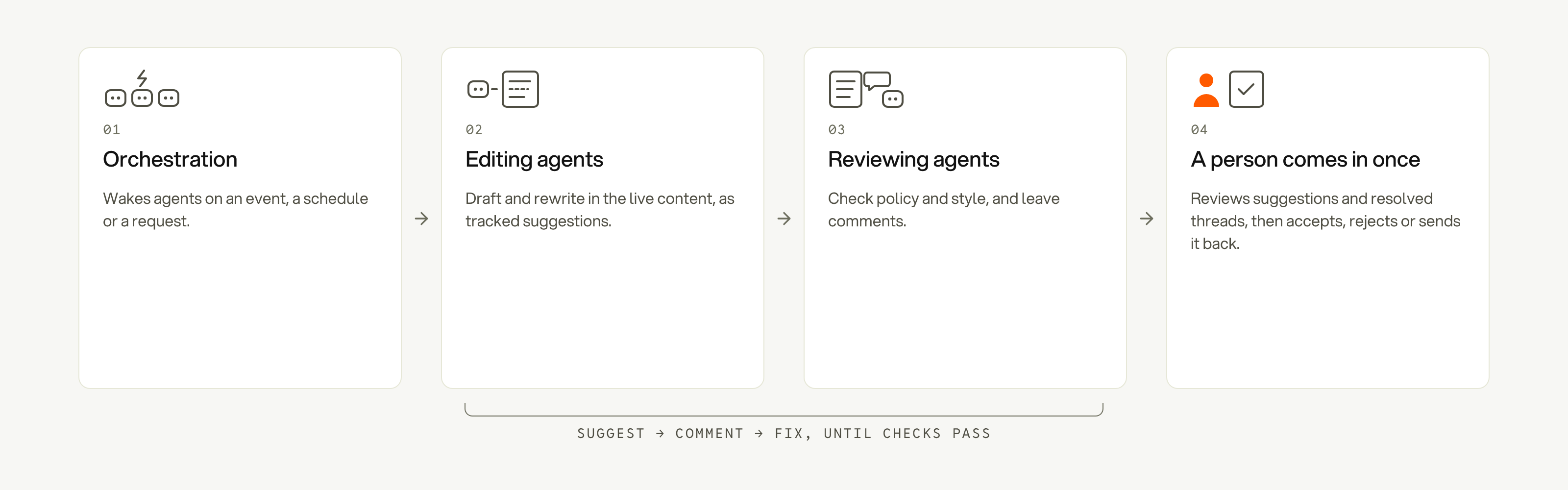
Figure 4. Agentic writing in four steps: agents suggest, comment and fix until the checks pass, and a person comes in once at the end.
A closing word
We have spent three years learning what it takes for a machine's writing to be trusted by the people who have to sign it, and it turned out to be the business we were already in. The editor was always the place where content gets checked, argued over and approved. Agents have made that place matter more. Whoever writes the first draft, a model in a chat window or an agent on a server, the document still ends up in an application a company trusts, in front of a person who decides. We intend to be the editor inside that application. And we are working with AI labs and assistant platforms so that whichever model writes the draft, it arrives there ready to review.